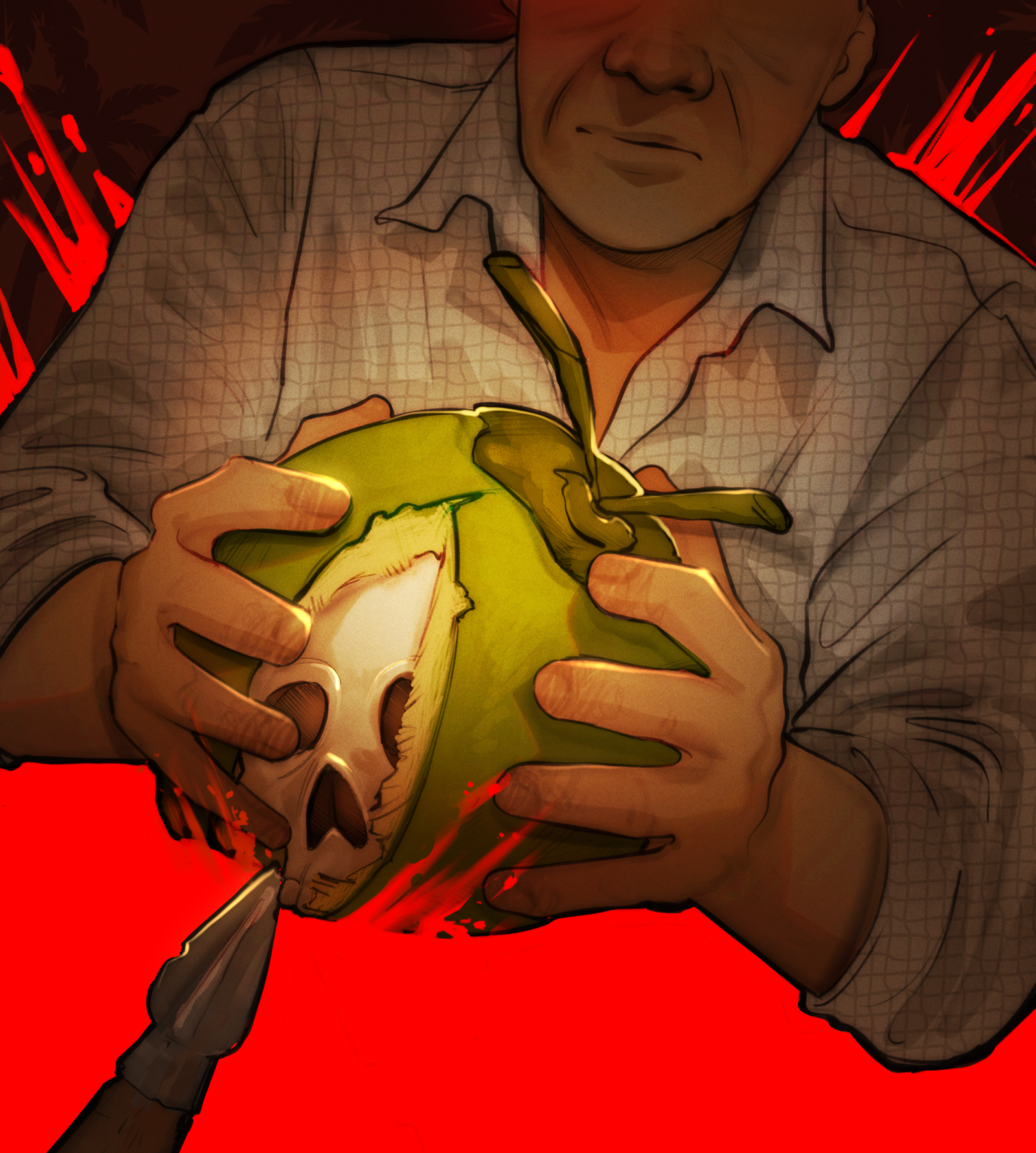

Every sack of copra carried a promise of development. In Guinayangan, the farmers who asked where that promise went were met with gunfire.
Before the coco levy became a fund, a corporate asset, or a case argued, it was money a farmer did not bring home.
It was collected at the first sale of every 100 kilograms of copra– the dried coconut meat from which oil is extracted. What appeared on paper as a small charge came from coconuts that had been grown, gathered, dried, carried, and sold by families who depended on each harvest
For them, even fifty-five centavos belonged to a larger calculation: food on the table, another day of work, or another season waiting for the land to provide again.
The government called the levy an investment.
Farmers would receive receipts that could later become shares, while the money collected from them would develop the coconut industry. The promise was simple: give up a portion of the harvest today and share in a better future tomorrow.
But promises become heavier the longer the people are made to wait.
On February 1, 1981, coconut farmers from five towns in Quezon made their way toward the Guinayangan plaza.
They came carrying grievances over the coco levy and the intensified militarization of their communities. They wanted an accounting of the money collected from their livelihood and an end to the fear surrounding the places they called home.
Martial Law had formally been lifted only fifteen days earlier.
The declaration had ended on paper, but the Marcos regime remained in power. For those who dared to question it, the danger had not disappeared.
Among those who helped organize the rally was Eliseo Dapog, a barangay captain who had learned early how much of a family’s future could rest on what the land produced.
Dapog was the eldest of nine children born to a farming couple in Quezon. His parents could put food on the table, but they could not afford to send their children to school beyond the elementary grades.
When his father became ill, Dapog helped carry the responsibility for the family and their six-hectare farm, where they grew rice and corn.
The land taught him how people could work hard and still be left with too little. His community taught him what could happen when those same people were made afraid to speak.
By 1978, Dapog had become barangay captain. As villagers in Guinayangan and nearby communities were detained, tortured, or killed on suspicion of opposing the government, he became one of the local leaders willing to denounce the abuses.
Silence might have kept him safer.
He chose to speak.
As the farmers approached the Guinayangan plaza, military forces opened fire.
Two farmers were killed.
Twenty-seven others were wounded.
The incident became known as the Guinayangan massacre.
Historical records can hold the tragedy in a single sentence. They can preserve the data, the place, and the number of bodies struck by bullets.
But numbers cannot tell us what the survivors carried home.
They cannot measure the emptiness left by a person who did not return, the fear of those who watched a peaceful march become a massacre, or the memory attached to a plaza where people had only wanted to be heard.
The gunfire lasted only moments, but the dispute that brought the farmers there had been growing for nearly a decade.
On June 19, 1971, Republic Act No. 6260 established the Coconut Investment Fund and imposed a levy of ₱0.55 on the first domestic sale of every 100 kilograms of copra or its equivalent in other coconut products.
Of every ₱0.55 collected, ₱0.50 went to the fund. In return, farmers were supposed to receive receipts that could eventually be converted into shares in the company administering it.
On paper, they were not merely paying into the industry. They were supposed to become part-owners of what their money built.
Under Martial Law, however, the system became larger and more difficult for ordinary farmers to follow.
In 1973, Presidential Decree No. 276 created the Coconut Consumers Stabilization Fund and imposed an initial levy of ₱15 for every 100 kilograms of copra sold.
Later decrees and directives sent portions of the collections into banks, oil mills, and other corporate investments. The money that left farmers in coins and deductions retired as shares and properties held far from the farms where it began.
One trail led back to Quezon.
Southern Luzon Coconut Oil Mills in Mulanay became part of six oil-mill companies acquired and financed through coconut levy funds. The Supreme Court would later affirm that these companies were government assets intended for the benefit of coconut farmers and the development of their industry.
The money had returned to the province as a corporate asset– not as cash retired directly to the hands that had produced it.
According to the Presidential Commision on Good Government, ₱9.695 billion in coco levies was collected from 1973 to 1983.
The billions reveal how large the fund became.
They also risk hiding where it began.
Before there were banks, companies, and court cases, there was a farmer standing beside a harvest and receiving less than its full value because part of it had been taken in the name of a future that remained beyond reach.
By the time the farmers marched toward Guinayangan, the issue was no longer only how much had been collected.
It was about trust.
Who controlled what their labor had built? Who benefited from the money taken in their name? How long were they expected to wait before the promise finally reached them?
In Guinayangan, those questions were met with gunfire.
The massacre could have taught Dapog to remain silent. Instead, he continued helping residents tell the stories that fear had forced them to hide.
Twice in 1984, Dapog hosted fact-finding missions conducted by the Task Force Detainees of the Philippines to document continuing abuses. Before the investigators arrived, he went around the community encouraging residents to overcome their fear and tell the truth, according to Bantayog ng mga Bayani.
He also signed a resolution asking the Batasang Pambansa to investigate human rights violations in Quezon, even as other local leaders remained silent out of fear for their lives.
Four years after the massacre, Dapog boarded a passenger bus bound for Los Baños, where he was expected to speak at another protest rally.
In Gumaca, three masked armed men stopped the vehicle and forced him to leave with them.
Gunshots were heard moments later.
Dapog was subsequently found dead with wounds to his forehead, neck, and chest.
His body was taken back to the Guinayangan municipal hall. For four days, thousands came to mourn him, filling the building and overflowing into the surrounding streets.
The man who had asked frightened residents to tell the truth could no longer speak.
So the community came out of its homes and spoke through its presence.
The Marcos regime ended in 1986
The farmers’ waiting did not.
Court battles over the ownership and recovery of coconut levy assets continued for decades. Only in 2021– 40 years after the Guinayangan massacre, did Republic Act No. 11524 create the Coconut Farmers and Industry Trust Fund.
Forty years is enough time for children to become parents, for witnesses to grow old, and for one harvest to be followed by another until waiting begins to resemble forgetting.
The law finally established a mechanism for recovered levy assets to benefit coconut farmers and their industry.
It could direct where the recovered money should go.
It could not return the farmers killed in Guinayangan, erase the wounds of those who survived, or complete the journey Dapog never finished.
Coconut became copra.
Copra carried a levy.
The levy became funds, banks, mills, and corporate assets.
The demand for answers became a march– and the march was met with bullets.
Quezon’s coconut trees still stand across the land that fed the levy.
They cannot testify, and their trunks keep no accounts.
But every time this story is told, the farmers reach the plaza again– not as figures in a historical record, but as people who asked to be heard.
The remembering, and the accounting, belong to the living