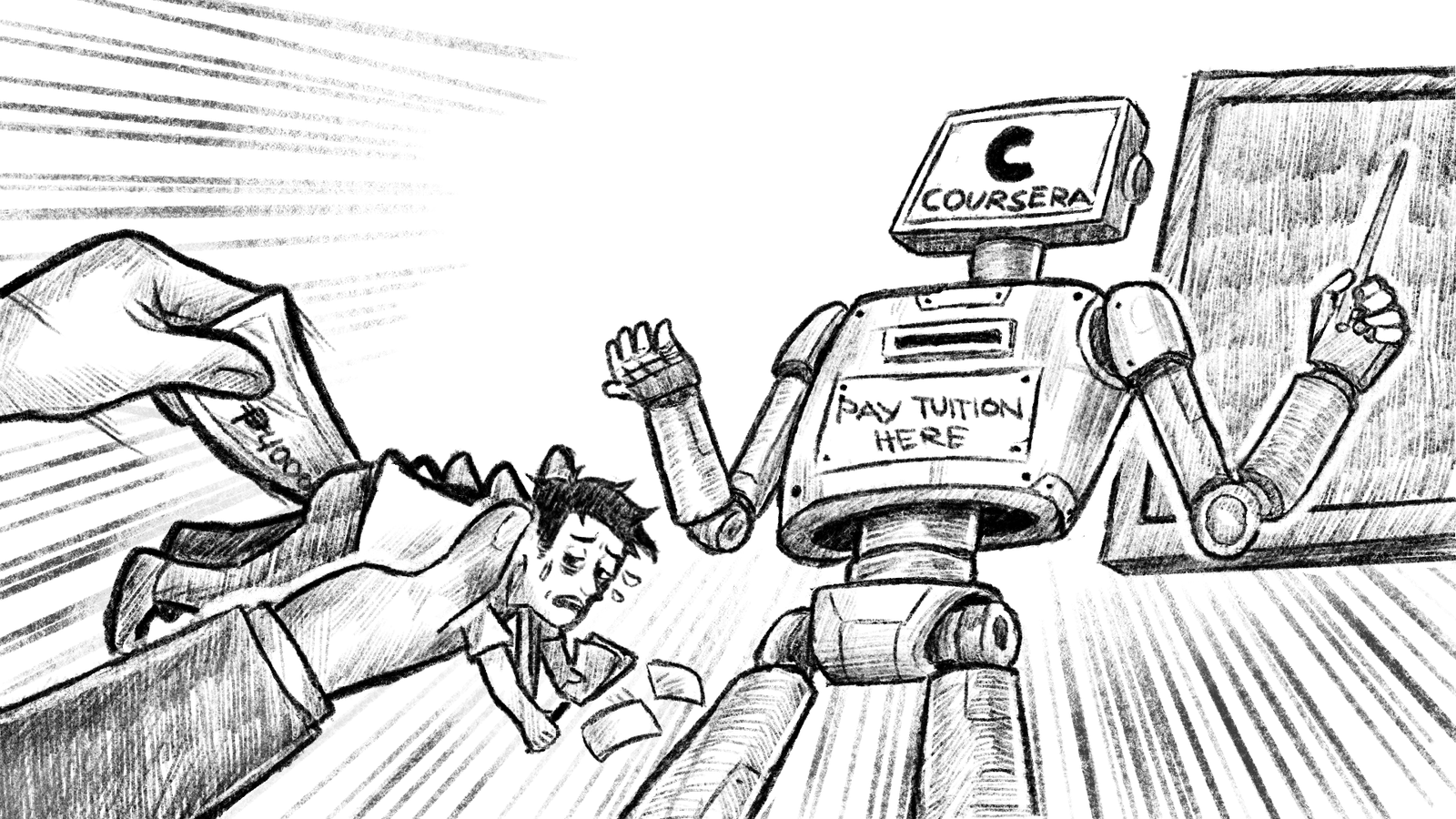

At the Manuel S. Enverga University Foundation (MSEUF), education is becoming an expanding expense as instruction is outsourced to overpriced modules. Hundreds of students, particularly in the College of Computing and Multimedia Studies and the College of Engineering, are now required to complete paid Coursera modules on top of their full academic load and tuition, while some professors step aside.
This arrangement replaces parts of classroom instruction to make room for pre-recorded lectures. According to responses gathered by The Luzonian, several students shared that they spent paid class hours watching Coursera videos with little to no engagement from their professors. Instead of enhancing instruction, some professors use Coursera to fill in what should be faculty-led hours.
With this setup, MSEUF students, who already pay for course units, are now required to pay an additional ₱4,000 per semester for the said platform. In effect, they are being charged more for less faculty engagement. This is troubling, as students are shouldering extra costs for learning that, in principle, their tuition should already cover.
This essentially outsources instruction to a third party platform students must pay extra for. If professors are allowed to offload their teaching duties, students end up paying more while receiving less value for their tuition. Coursera, a digital learning platform known for self-paced courses from foreign universities, has been marketed for its ‘flexibility’ and ‘global exposure.’ But these buzzwords only mask a deeper contradiction between the university’s promises and its practices.
Some subjects even require multiple Coursera modules, demanding hours that far exceed the standard load for a single course. And without structured discussions, some students find the material flat and disconnected. One student described the experience as ‘online classes all over again, but with added fees’; another compared it to ‘YouTube University.’
Coursera indeed offers value through access to thousands of courses from global universities. However, mandating its use as a substitute for in-person teaching, especially when students are given no say in how it’s used, undermines that value.
As one anonymous student said, “I think having access to Coursera is a great opportunity for students to expand their learning … especially in fields like IT where credentials matter. However, its essence of [being] ‘self-paced’ starts to get lost when professors impose strict deadlines or use Coursera as a replacement for teaching.”
Coursera’s integration into the curriculum not only restructures learning but also shifts its cost onto students without transparency or consent. While MSEUF held seminars and promoted the platform to gain support among the students, the so-called ‘microcredentials fee’ was already buried into registration forms without clear notice or explanation.
For lower-income students, the burden is heavier. Being charged extra for the same learning outcome is not only counterintuitive but unjustifiable. To some students, this doesn’t feel like innovation. It feels exploitative.
On March 6, the university even held a consultative meeting with Coursera executives to discuss its expansion. While the university praised the partnership as a way to “enhance digital learning,” students—the very individuals expected to fund and complete these courses—were given no seat at the table.
Hundreds of CCMS and CEng students have effectively become test subjects for this poorly integrated initiative. If the program expands without thorough evaluation and student input, it risks setting a dangerous precedent across the university.
This is also the case in several private institutions such as Mapúa, Lyceum of the Philippines University, Saint Louis University, and Ateneo De Naga University, where Coursera is integrated in some academic departments and comes with additional fees varying by program.
By contrast, students in other institutions such as the University of the Philippines Diliman who also partnered with Coursera, are given the option to take modules on a voluntary basis and not as mandatory coursework. This approach respects student agency and affirms that online platforms should supplement, not substitute, classroom instruction.
There is nothing wrong with modernizing instruction. But MSEUF has embedded Coursera into its curriculum in a way that sidelines both educators’ responsibilities and students’ rights.
Education should not be treated as a transactional partnership with a third-party platform—especially when that partnership compromises instructional quality, increases student costs, and allows faculty responsibilities to be replaced by pre-packaged content.
While it is true that the university does not take a percentage of the ₱4,000 microcredentials fee, its partnership with a profit-driven company undermines its mission as a non-profit educational foundation. If MSEUF is sincere in upholding accessible learning, it should at the very least subsidize this platform for low-income students.
Transparency and accountability are not optional; they are the bare minimum. With Coursera, students are paying more while receiving less engagement from professors, and shouldering the cost of a poorly integrated initiative imposed without their input. True partnership for the goals requires involving all stakeholders in decision-making. Until the university begins to treat its students as partners and not passive customers, every claim of academic innovation will remain hollow.
To move forward, the university must rethink how it integrates third-party platforms like Coursera into its curriculum. Clear guidelines should be developed to ensure that such tools enhance and not replace faculty instruction. If digital learning is to be part of MSEUF’s future, then that future must be built with transparency, student participation, and a genuine commitment to educational equity at its core.